Accessibility Tools

Ten thousand years – that’s how long ago people appeared in the area of present-day Gdynia. They did not follow mammoths, giant sloths or sabre-toothed tigers, or at least there is no evidence of that. Our area back then remains to be something of a mystery. Unexplored. However, a thousand years ago settlement had already become permanent, and fortified strongholds and villages were expanding and gaining in strength. In 1253, Gdynia was first mentioned in a document that has survived to this day. Recorded – from that moment on, we can speak of Gdynia by name. The surrounding villages had different owners, though none of them belonged to the Adamczewski family — yes, as in Poland’s hit historical series 1670 (we really did check!). Their development depended on the strength of the region and the country’s condition. When Poland fell to the partitioning powers, new governments came to rule and new times began. Alluring – in the “long” 19th century Gdynia began to transform into a seaside resort. That’s how the Second Polish Republic found it.
Poland's regaining of independence in 1918 brought with it access to the Baltic Sea (in 1920). Its short stretch of coastline ended just before Sopot, which was part of the Free City of Gdańsk.
Poland needed a seaport: for importing weapons, for its Navy, for handling migration, for exporting goods... In 1920, the expert eye of engineer Tadeusz Wenda identified Gdynia as the ideal location, and construction of the port soon began – later confirmed by an act of law. Thanks to the determination of the authorities, with the involvement of extraordinary effort and resources, within just over a decade Poland built one of the most modern and largest ports in Europe – a fleet base, transport hub, centre of trade, industry and services.

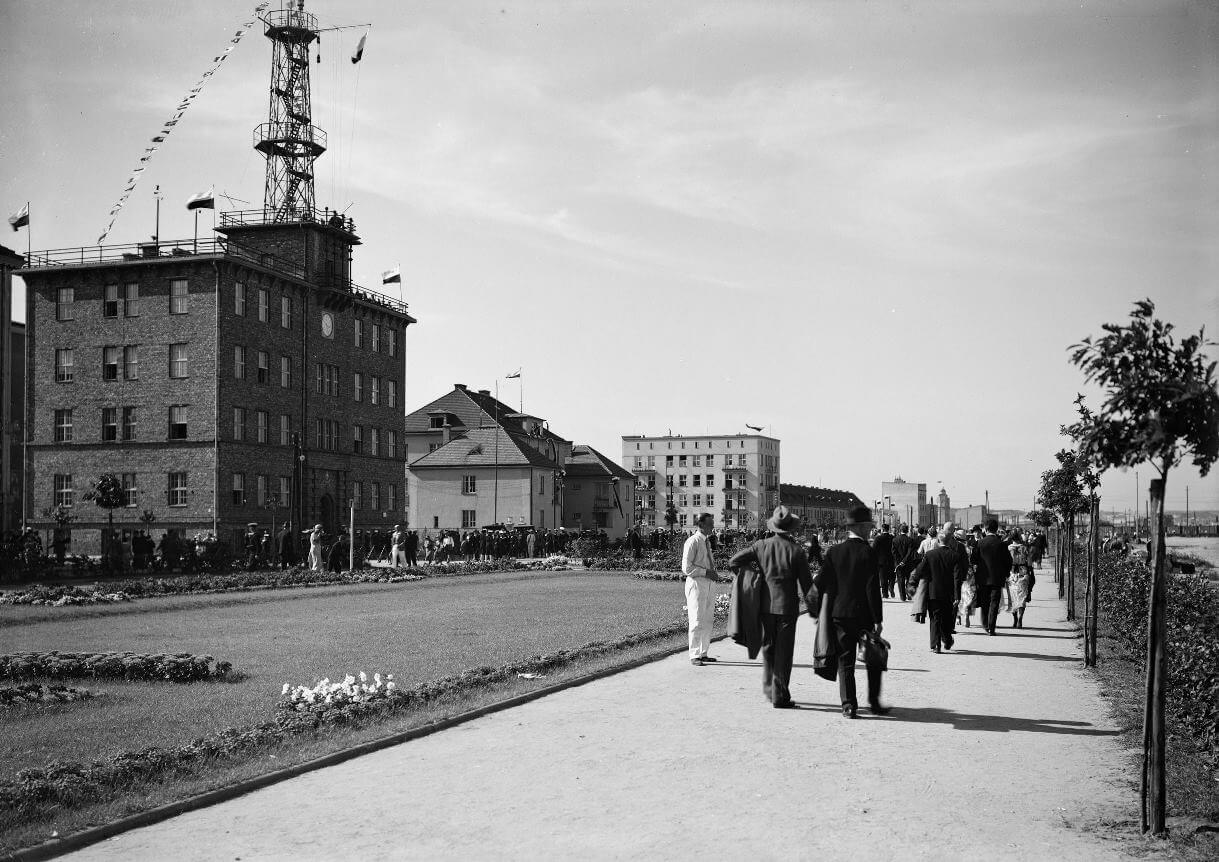
The port of Gdynia had an impact on its neighbourhood, the Pomeranian region, the country, as well as the Baltic area and international relations. However, it first and foremost transformed Gdynia itself, accompanying it on its journey from a summer resort village with a population of 1,300 to a city of 127,000, rich in diverse customs and cultures. What united the people of that time was hard work, adaptability, and a spirit of modernity, expressed in accordance with scale and possibilities – for example, through modernist architecture. The city grew thanks to state support and private investment. Boldly and without hesitation, it incorporated the surrounding towns, seducing others (and itself) with the “Great Gdynia” slogan. The measure of this greatness was not limited to numbers. Government offices moved to the city (including those from Wejherowo and Puck), new institutions were established, and businesses flourished. Gdynia worked tirelessly to earn its position and build its brand.
History can be ironic – Gdynia’s brand was soon replaced by that of the Third Reich, when Gdynia and Pomerania were incorporated into Nazi Germany. Despite brave defence and countless sacrifices, the tragedy of occupation could not be avoided. That occupation – already under the name Gotenhafen (as the Nazis renamed Gdynia) – was marked by the blood of Polish citizens, here the inhabitants of Gdynia, shed during executions in the Piaśnica Forests, in the Stutthof camp, as a result of repressions, deportations, the so-called death marches, air raids and shelling, evacuations, underground resistance, and on the war fronts...
Amid all this hopelessness, the Polish people persevered. Those who had avoided deportation from the city and those who had been relocated and forced to live on its crowded outskirts. Heroes without capes. Some worked to support themselves and their loved ones. Others were active in the Secret Scouts Troop or in the underground military organisation, Pomeranian Griffin. Some were getting married, and when love proved stronger than fear, children were born. They found themselves in the brutal reality of the “time of storms”, years marked by uncertainty.
There were also others – new residents. Relocated from the Reich or resettled from Latvia and Estonia, transferred from Italy or brought from the east as prisoners or prisoners of war. Some were born here. Gdynia was their port — even if not their home.
Was the “victory day” sunny? Both yes and no – figuratively and literally. Although the new political reality offered little reason for optimism, the war-torn country lacked the strength for another battle. In Gdynia, efforts began to tidy and rebuild the urban fabric, and to raise the much-needed port from the rubble. It was through the port of Gdynia that both international aid and displaced Poles were to reach the country. Returning and new residents revived or founded businesses and co-created enterprises in sectors such as fishing, shipbuilding and maritime transport. The fishing companies „Arka” and „Dalmor”, Gdynia Shipyard, Maritime Radio Service for Ships „MORS” and „Baltona” are just a few examples.
The People's Republic of Poland lasted a total of 45 years, a time when most of today’s Gdynia residents were born. Socialism and communism, the Eastern “Big Brother’s” influence, repression of groups and individuals, censorship, the greyness of everyday life, and an economy of scarcity were one side of the coin. Universal education, social security and healthcare were the other. Gdynia also grew – new pre-schools and schools were built, as well as facilities for dining, culture and sport... Housing estates providing a proper space for living were planned. At the same time, the city retained its port character, and the contacts and trade (including maritime trade) allowed for partial compensation for the shortages. No wonder that the nationwide popularity of Gdynia returned. And has remained ever since.
Black: a day, a week, a month, a year, a decade. The colour of mourning and loss, still carried in the hearts of some, despite the passing years. The events of December 1970 left a lasting mark on the city and its residents. On December 17th, when shipyard workers were approaching the Gdynia Stocznia station, shots were fired at them. Eighteen people were killed or later died of their wounds; more than two hundred were injured. Thousands witnessed the tragedy or were family members of the victims.
The other thousands could no longer be silenced. August 1980 arrived, bringing strikes in response to further price increases and acts of harassment. Soon, the Independent Self-Governing Trade Union “Solidarity” was founded. Neither martial law (1981-1983) and the internments, nor the subsequent repressions at the end of communism could stop the process of change – the walls came tumbling down...
The changes that followed 1989 were not easy for sovereign Poland – nor for Gdynia, now self-governed. Transformation became a dirty word. For the remnants of the socialist economy, including major industrial employers in Gdynia, it often meant collapse after years of slow decline. The so-called free market followed its own rules; unemployment was rampant. This is how Gdynia was forged...
However, the foreign contacts developed over decades (e.g. with sister cities and foreign partners), the advantage of the port, skilled workforce, and openness to new ideas, helped Gdynia get back on the right course much faster. We don’t ask when Gdynia joined Europe – for Europe has always been here. On the radio, at the market halls, in restaurants, and beyond. The Honorary Flag of Europe (1996), the Honorary Plaque of the Council of Europe (1998) and the Council of Europe's Europe Prize (2002) stand as the best examples of this.
Local government units and companies were established. The public transportation system was organised – soon becoming an inspiration for other cities. A safer and more accessible city was being created, education developed, and culture was invested in. Consistently, piece by piece – like assembling a giant puzzle. The strongest successfully navigated the changes, becoming the city's ambassadors abroad. Just like basketball players and those who work at sea. Gdynia is a champion in many fields – not only in sport.
Sails draw people during rallies, such as The Tall Ships’ Races; stars – during the Polish Film Festival and Open’er. Those seeking something more come for the Gdynia Literary Award or Gdynia Design Days. Those fascinated by history visit the Museum of the City of Gdynia and the Emigration Museum – for where better to discover the story of the city and its people than here?
Small or large, colourful or sepia-toned, fast and... even faster. Every kind of Gdynia — agricultural, fishing, resort, rural, port, business, innovative, cultural, historic, sporting, and even the German ‘-hafen’ Gdynia — belonged, in one way or another, to everyone. Created, supported, celebrated, defended, and rebuilt by the state and local government, by the community and society, by settlers and newcomers alike. This is our Gdynia, our Jubilant City. And may it remain so. Long live Gdynia — long live! You are so beautiful! And your history... is yet to unfold!